Ethos.
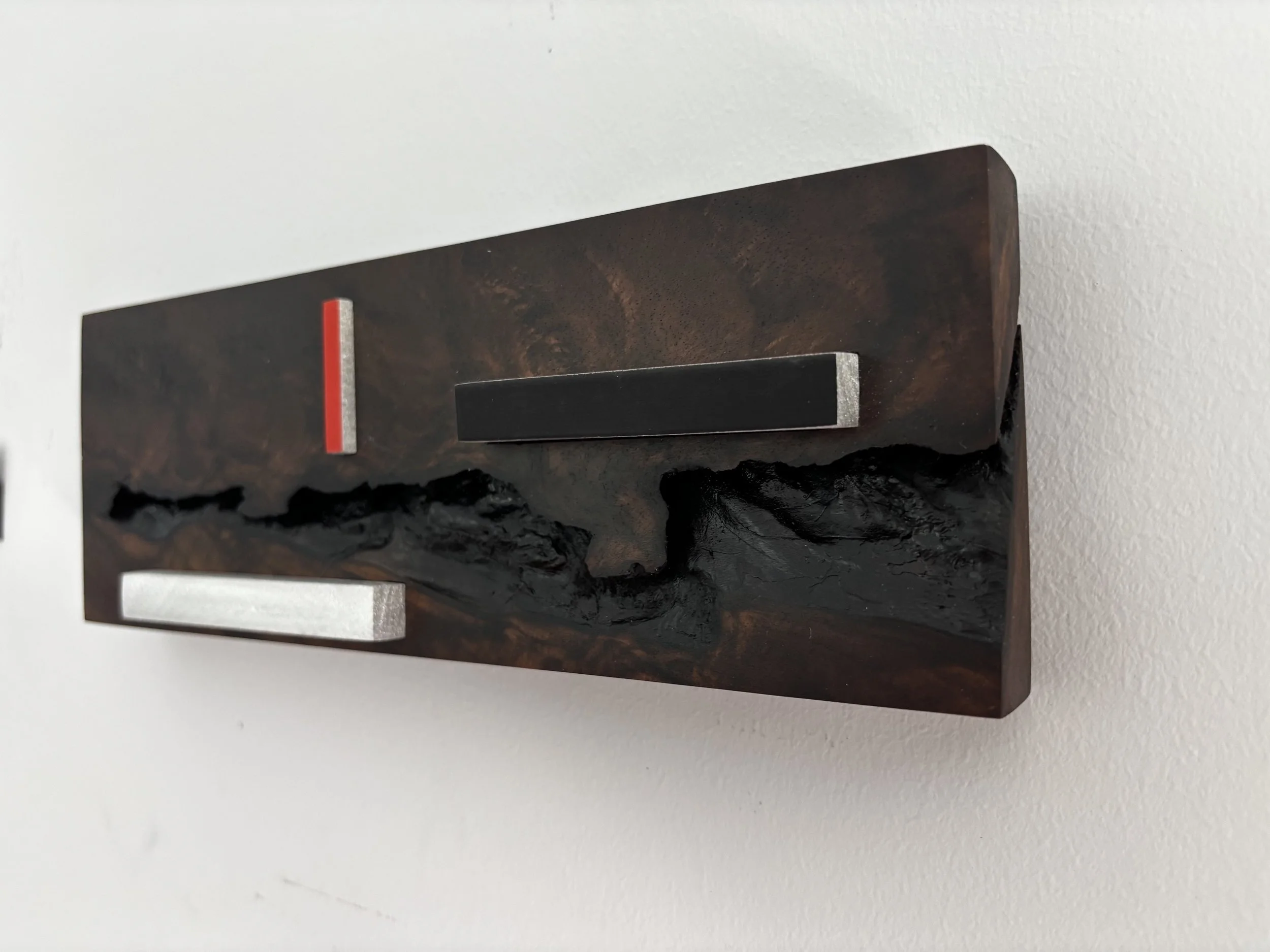
For me, the studio is a place where abstract and non-objective sculpture emerges through a negotiation between organic contingency and geometric intervention. Organic substrates provide a field shaped by growth, stress, damage, and chance. Rather than correcting or disguising them, I treat these features as parameters that establish the terms of the composition.
Against this material complexity, inorganic interventions are introduced. These elements belong to a different visual language: measured, manufactured, geometric, and deliberate. The material establishes the problem. Geometry constitutes the countermeasure.
The resulting works occupy a point of tension between two systems—growth and construction, contingency and control, irregularity and precision—without allowing either to fully dominate the other.
Informed by Constructivism, Suprematism, and geometric abstraction, the work treats elemental forms as an almost pre-linguistic system of signs. Position, proportion, tension, containment, and movement operate before the experience has been translated into words. Their physical and conceptual tension remains open, allowing meaning to emerge through the emotions, associations, and self-reflection each viewer brings to the work.
Origins.
I trace part of my sculptural language to a childhood spent in the wooded suburbs outside Pittsburgh, where industry and landscape were never truly separate. Forested hills were threaded with rail lines, bridges, retaining walls, and mills. Trees pressed against infrastructure; organic growth and engineered order occupied the same terrain.
That environment continues to inform the material logic of Helix & Hewn. Hardwood carries irregularity, time, and evidence of growth. Against it, I introduce rectilinear elements in metal, polymer, stone, and other materials—measured, manufactured, and deliberately imposed. The contrast is not simply between nature and industry, but between two systems: one contingent and adaptive, the other geometric and controlled.
My sculptures do not attempt to reconcile those systems. They hold them in sustained tension. Wood resists uniformity; geometry asserts structure. Voids, planes, channels, blocks, and projections interrupt the material without fully dominating it.
That relationship reflects something I absorbed early from the landscape around Pittsburgh: meaning can emerge where unlike systems are forced into proximity—where growth encounters structure, irregularity meets precision, and history confronts intention.