Who we are
At Helix & Hewn, no geometric intervention is arbitrary - each originates in a condition already present in the material.
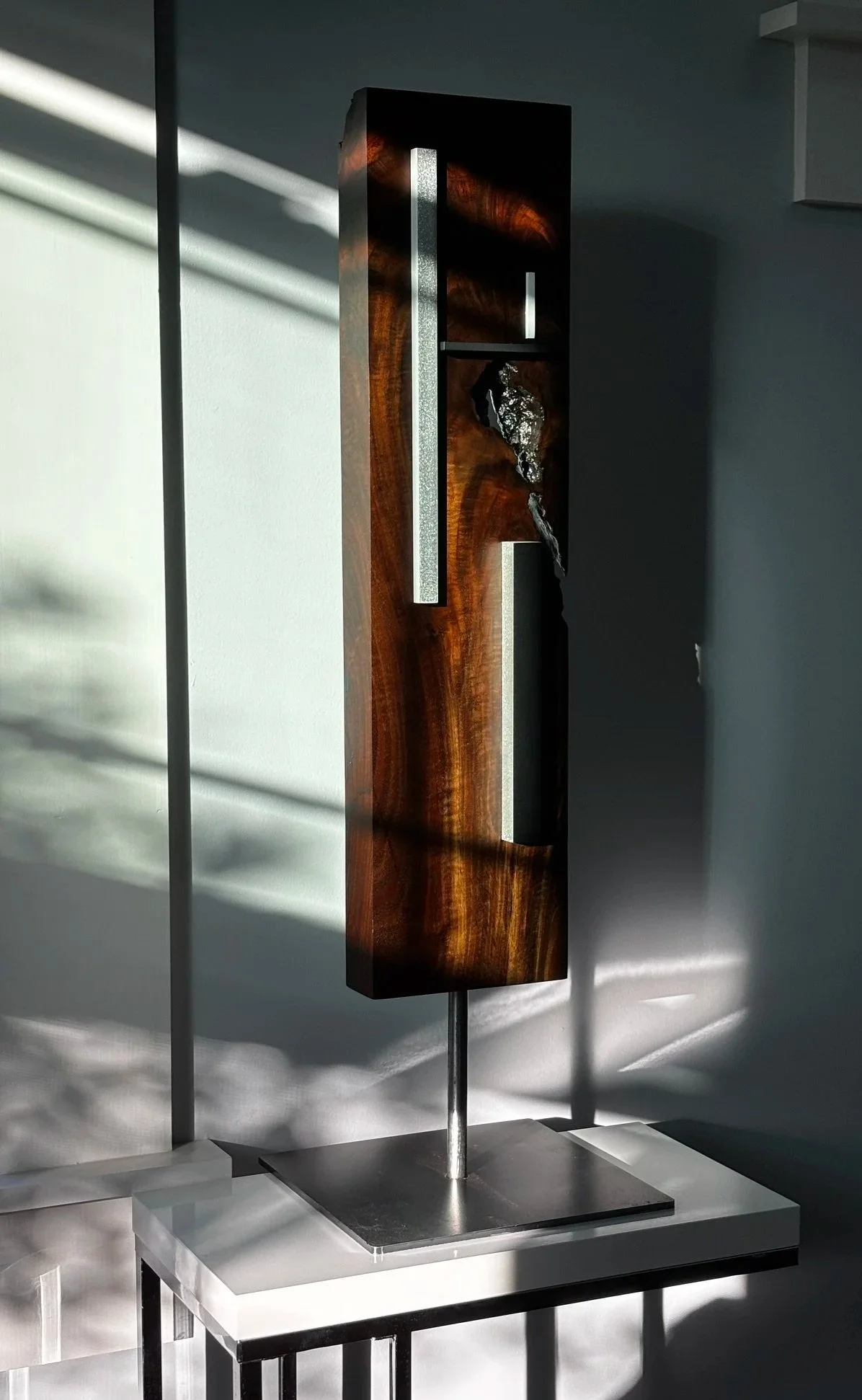
My work combines hardwood with metal, polymer, stone, and other materials to create mixed-media constructions shaped by tension between natural contingency and imposed order. Grain, knots, voids, fissures, and irregularities are not treated as defects to be concealed, but as conditions to which the work must respond.
The work begins with conditions already present in the material: a knot, crack, void, grain divergence, inclusion, or other interruption. These conditions determine where geometry may act. The resulting interventions are precise and deliberate, but their placement is not arbitrary; the material establishes the condition, and geometry becomes the response.
Developed outside academic sculpture programs, my practice is process-driven and materially led. Rather than beginning with a predetermined composition, I allow the particular character of each piece of wood to establish a problem. Precise geometric interventions—channels, apertures, planes, blocks, projections, and voids—then impose a different visual and structural logic upon it.
The work is informed by Constructivism, Suprematism, and geometric abstraction, while remaining grounded in the physical specificity of natural material. The resulting sculptures explore relationships between order and chance, control and resistance, support and instability, containment and release.
My background as a biomedical researcher continues to influence how I approach my work: through observation, experimentation, iteration, and an interest in how complex systems respond to intervention. Science is not the subject of the work so much as part of the method behind it—the habit of looking closely, identifying structure, and testing what happens when one condition is altered.
Helix & Hewn creates objects intended to reward sustained looking. Changes in material, surface, light, shadow, and viewpoint reveal relationships that may not be immediately apparent, inviting the viewer to consider not only what has been constructed, but the negotiation between the material and the intervention imposed upon it.
Robert E. Bakin, Ph.D.
Founder & Artist