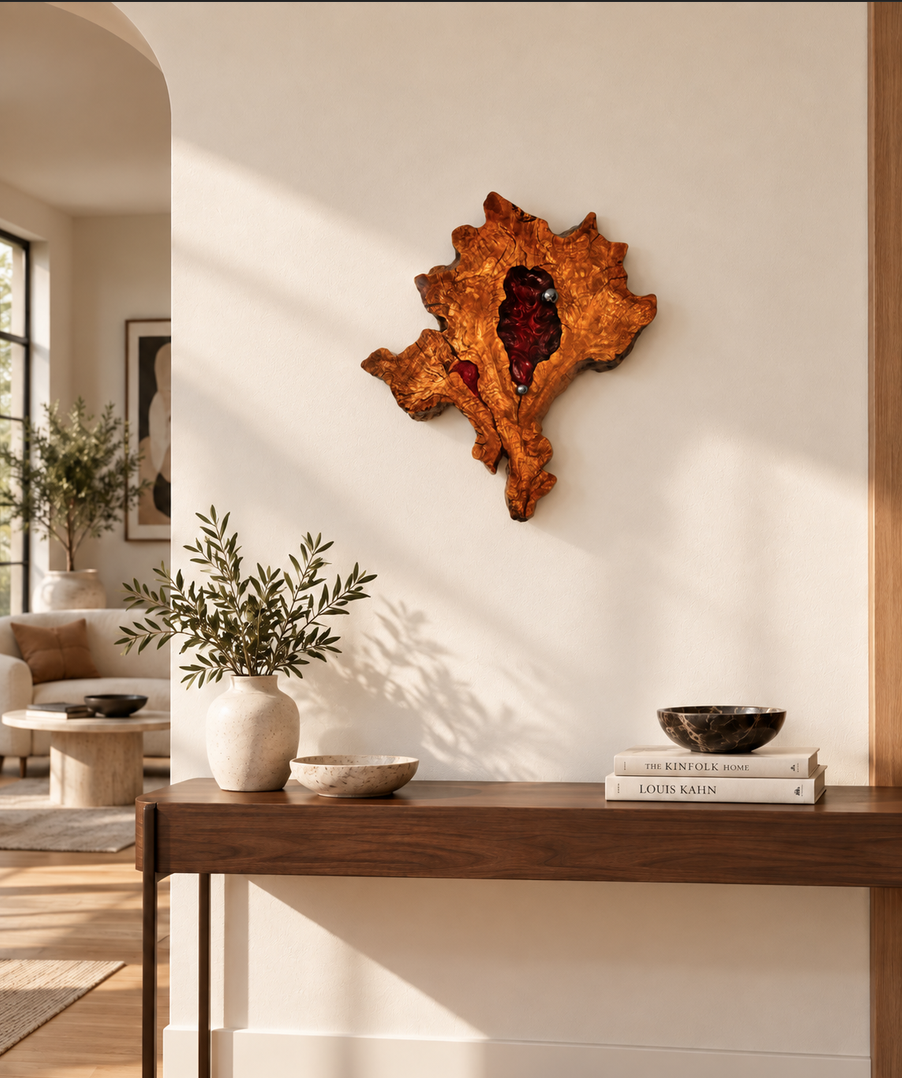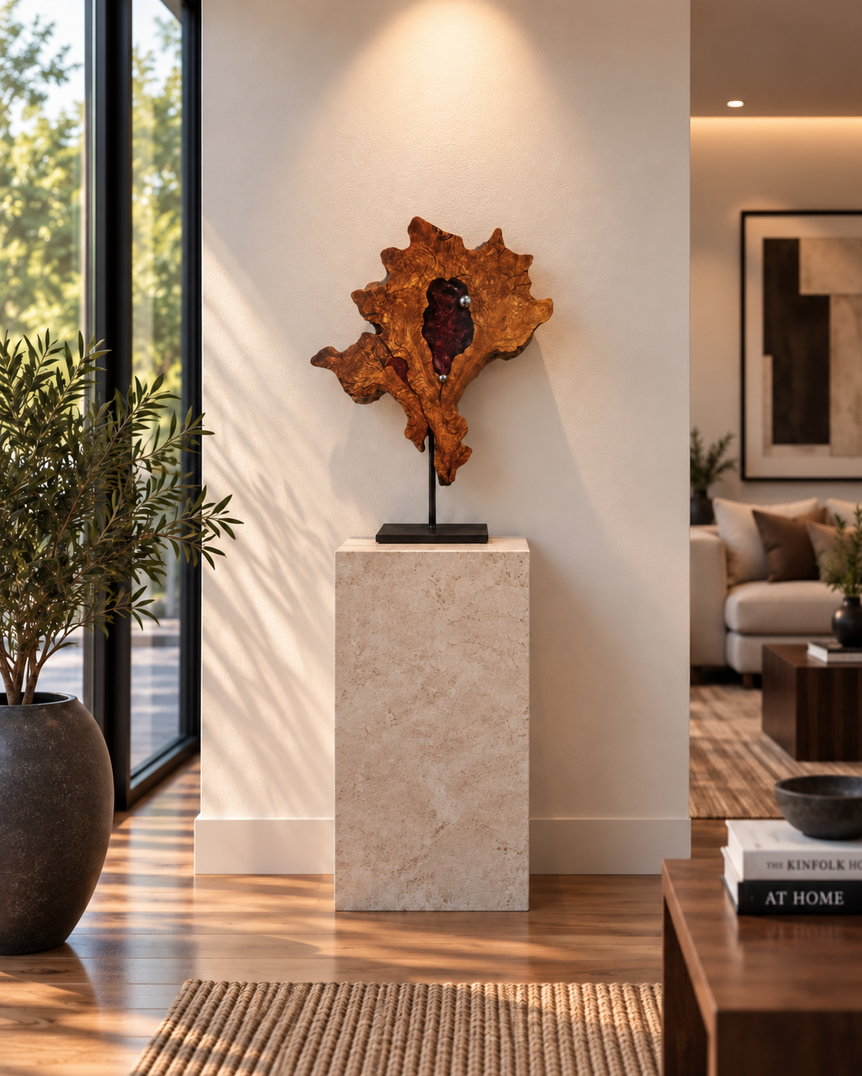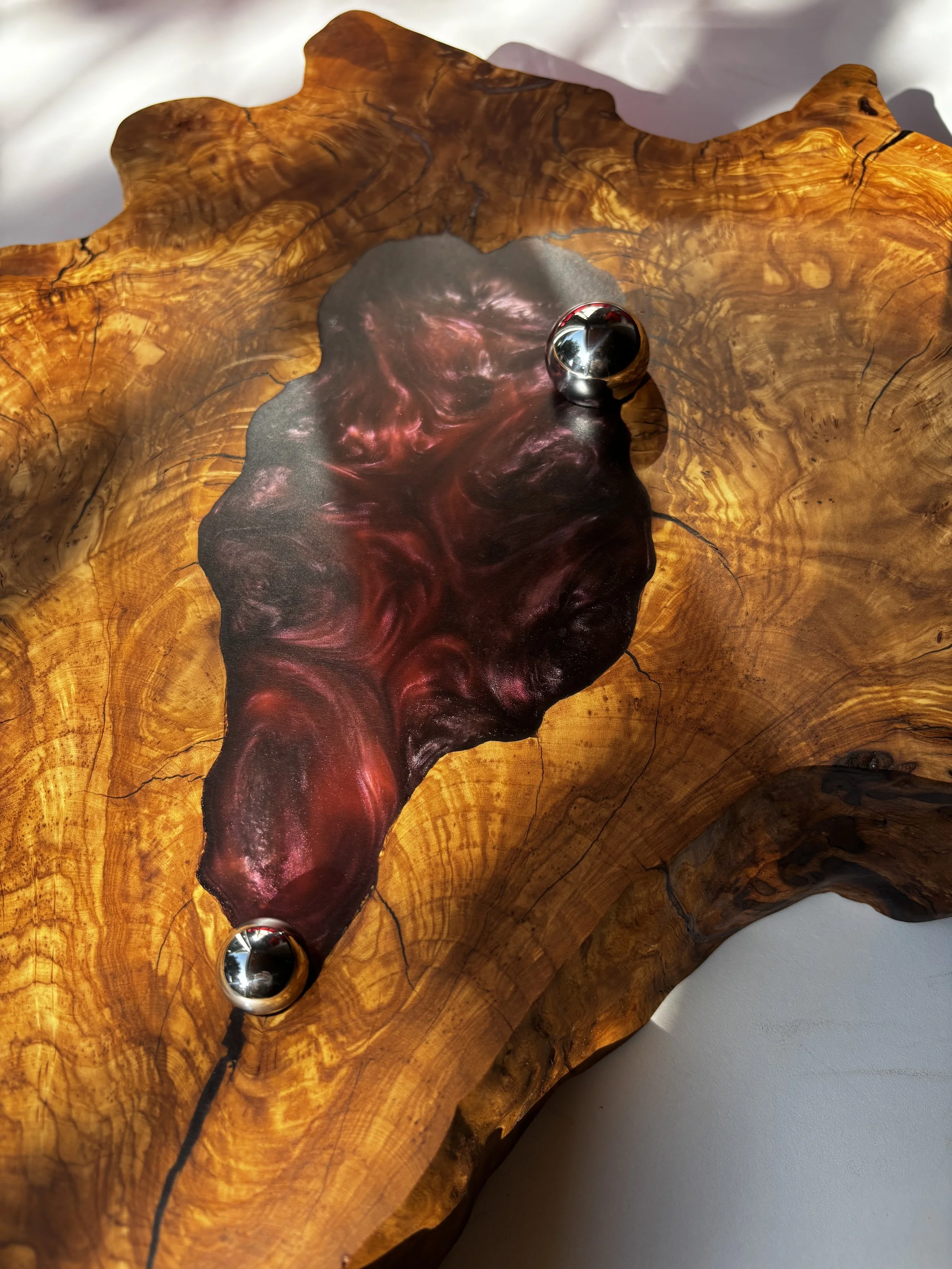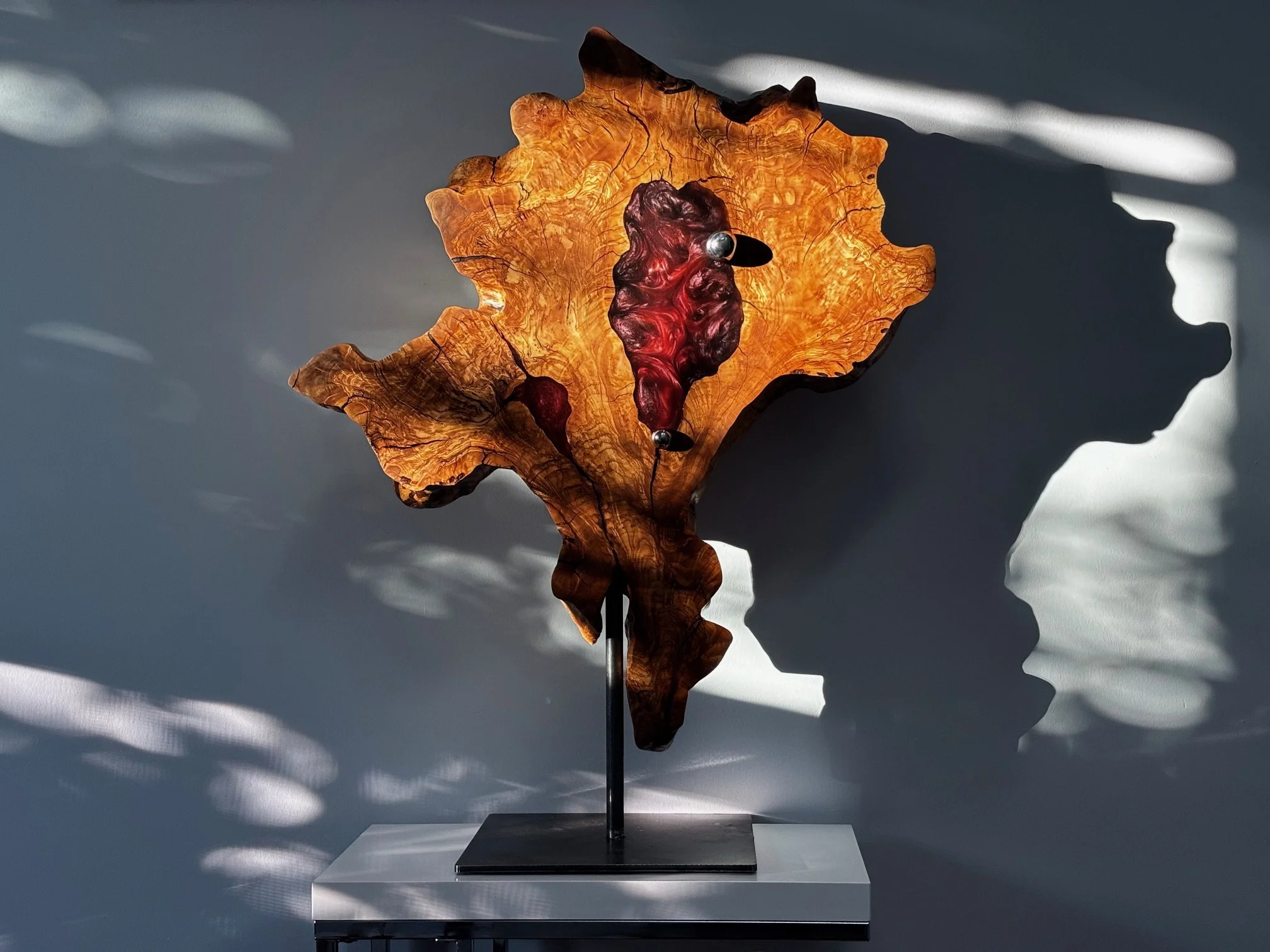
Olive wood (Olea europaea) with stainless steel and epoxy inlays.
17 lbs. 26” x 23” x 3”
Dizygotic draws its structure from the biological conditions under which life can emerge. The reclaimed wood forms an organic body shaped by time and growth, its internal voids and channels evoking the protected environment in which early development occurs.
Red epoxy courses through the wood as a metaphor for ovarian blood vasculature—circulatory pathways essential to sustaining nascent life. Embedded within this vascular network are two spheres, representing fertilized embryos formed independently yet sustained within a shared biological environment. Their identical material underscores simultaneity, while their distinct positions reflect divergence from the earliest stages. Though supported by the same circulatory system, each occupies its own spatial and developmental trajectory.
Dizygotic examines how biological systems enable multiplicity without uniformity. It presents life not as a singular origin, but as parallel emergence—where nourishment is communal, conditions are shared, and individuality begins before form is fully realized.
Olive wood (Olea europaea) with stainless steel and epoxy inlays.
17 lbs. 26” x 23” x 3”
Dizygotic draws its structure from the biological conditions under which life can emerge. The reclaimed wood forms an organic body shaped by time and growth, its internal voids and channels evoking the protected environment in which early development occurs.
Red epoxy courses through the wood as a metaphor for ovarian blood vasculature—circulatory pathways essential to sustaining nascent life. Embedded within this vascular network are two spheres, representing fertilized embryos formed independently yet sustained within a shared biological environment. Their identical material underscores simultaneity, while their distinct positions reflect divergence from the earliest stages. Though supported by the same circulatory system, each occupies its own spatial and developmental trajectory.
Dizygotic examines how biological systems enable multiplicity without uniformity. It presents life not as a singular origin, but as parallel emergence—where nourishment is communal, conditions are shared, and individuality begins before form is fully realized.