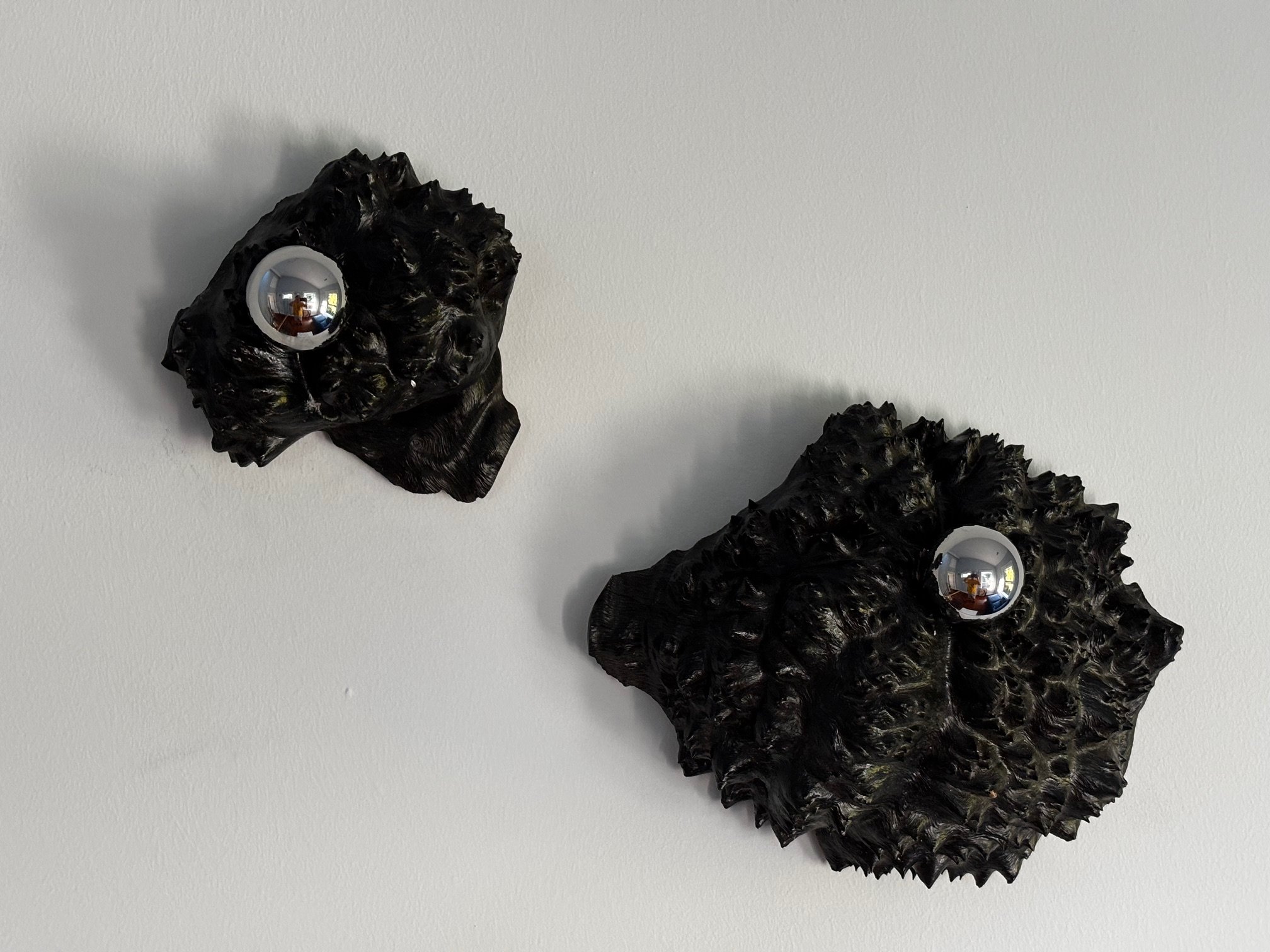
Australian Red Mallee Burl and stainless steel.
4 lbs. 7" x 6" x 3"
In Entanglement, two small wall-mounted black eucalyptus burls face one another across a narrow gap, each containing an oversized stainless steel sphere. The darkened mass of each burl reads as a quantum field made visible—an irregular ground of latent energy from which localized fluctuations seem to emerge.
Set within each burl, the mirrored spheres operate as both formal anchor and conceptual charge. They represent quantum-entangled ions: distinct bodies whose condition cannot be fully understood in isolation, because each remains bound to the state of the other across space and time. In this manner, each sphere derives meaning through its relationship to the other. The small separation between the two forms is therefore not incidental, but essential. It gives physical expression to distance while intensifying the fact of connection, echoing the paradox Einstein famously described as “spooky action at a distance.” The system they create cannot be understood by examining a single element in isolation, rather, stability emerges only from mutual dependence.
The sculpture occupies a threshold between autonomy and dependence. Though the two bodies do not touch, they remain visually and conceptually inseparable. Entanglement proposes that distance does not necessarily weaken connection but can instead make its mystery more visible—revealing how separation itself may become the very condition through which linked systems are understood.
Australian Red Mallee Burl and stainless steel.
4 lbs. 7" x 6" x 3"
In Entanglement, two small wall-mounted black eucalyptus burls face one another across a narrow gap, each containing an oversized stainless steel sphere. The darkened mass of each burl reads as a quantum field made visible—an irregular ground of latent energy from which localized fluctuations seem to emerge.
Set within each burl, the mirrored spheres operate as both formal anchor and conceptual charge. They represent quantum-entangled ions: distinct bodies whose condition cannot be fully understood in isolation, because each remains bound to the state of the other across space and time. In this manner, each sphere derives meaning through its relationship to the other. The small separation between the two forms is therefore not incidental, but essential. It gives physical expression to distance while intensifying the fact of connection, echoing the paradox Einstein famously described as “spooky action at a distance.” The system they create cannot be understood by examining a single element in isolation, rather, stability emerges only from mutual dependence.
The sculpture occupies a threshold between autonomy and dependence. Though the two bodies do not touch, they remain visually and conceptually inseparable. Entanglement proposes that distance does not necessarily weaken connection but can instead make its mystery more visible—revealing how separation itself may become the very condition through which linked systems are understood.