Brown Mallee Burl (Eucalyptus thamnoides) and stainless steel.
4.5 lbs. 10" x 9" x 1.5"
Lightning Seeds takes its form from a suspended field of origin—dense, unsettled, and charged with unrealized possibility. The eucalyptus burl cross-section carries this resemblance not by design, but by growth: layered, turbulent, and shaped by forces that remain distributed across matter itself.
The wood represents a generative field—an atmosphere not of weather, but of becoming. Embedded within this field are metallic spheres. They do not depict stars or planets already formed, but potential: points at which matter begins to condense. Each sphere marks a threshold—a place where something could come into being, but has not yet fully emerged. The spheres vary in size and depth, suggesting that not all potential is equal. Some are dominant, others embryonic. None is complete. The cosmos remains in formation.
Lightning Seeds is not about the finished universe, but about the moment before intelligibility—when energy is unevenly distributed, outcomes remain uncertain, and existence itself is held in tension between latency and arrival.
Brown Mallee Burl (Eucalyptus thamnoides) and stainless steel.
4.5 lbs. 10" x 9" x 1.5"
Lightning Seeds takes its form from a suspended field of origin—dense, unsettled, and charged with unrealized possibility. The eucalyptus burl cross-section carries this resemblance not by design, but by growth: layered, turbulent, and shaped by forces that remain distributed across matter itself.
The wood represents a generative field—an atmosphere not of weather, but of becoming. Embedded within this field are metallic spheres. They do not depict stars or planets already formed, but potential: points at which matter begins to condense. Each sphere marks a threshold—a place where something could come into being, but has not yet fully emerged. The spheres vary in size and depth, suggesting that not all potential is equal. Some are dominant, others embryonic. None is complete. The cosmos remains in formation.
Lightning Seeds is not about the finished universe, but about the moment before intelligibility—when energy is unevenly distributed, outcomes remain uncertain, and existence itself is held in tension between latency and arrival.

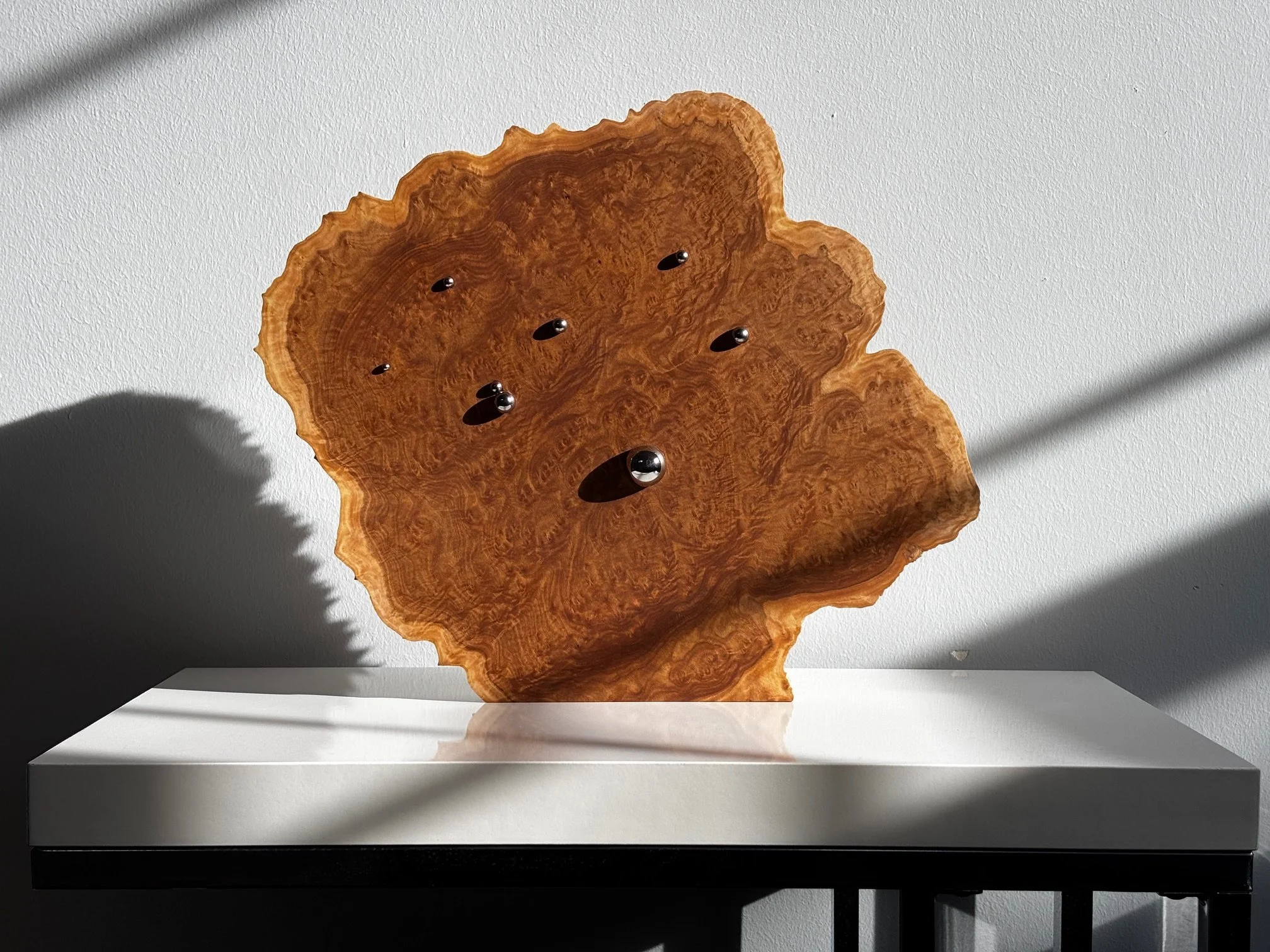 Image 1 of 8
 Image 2 of 8
 Image 3 of 8
 Image 4 of 8
 Image 5 of 8
 Image 6 of 8
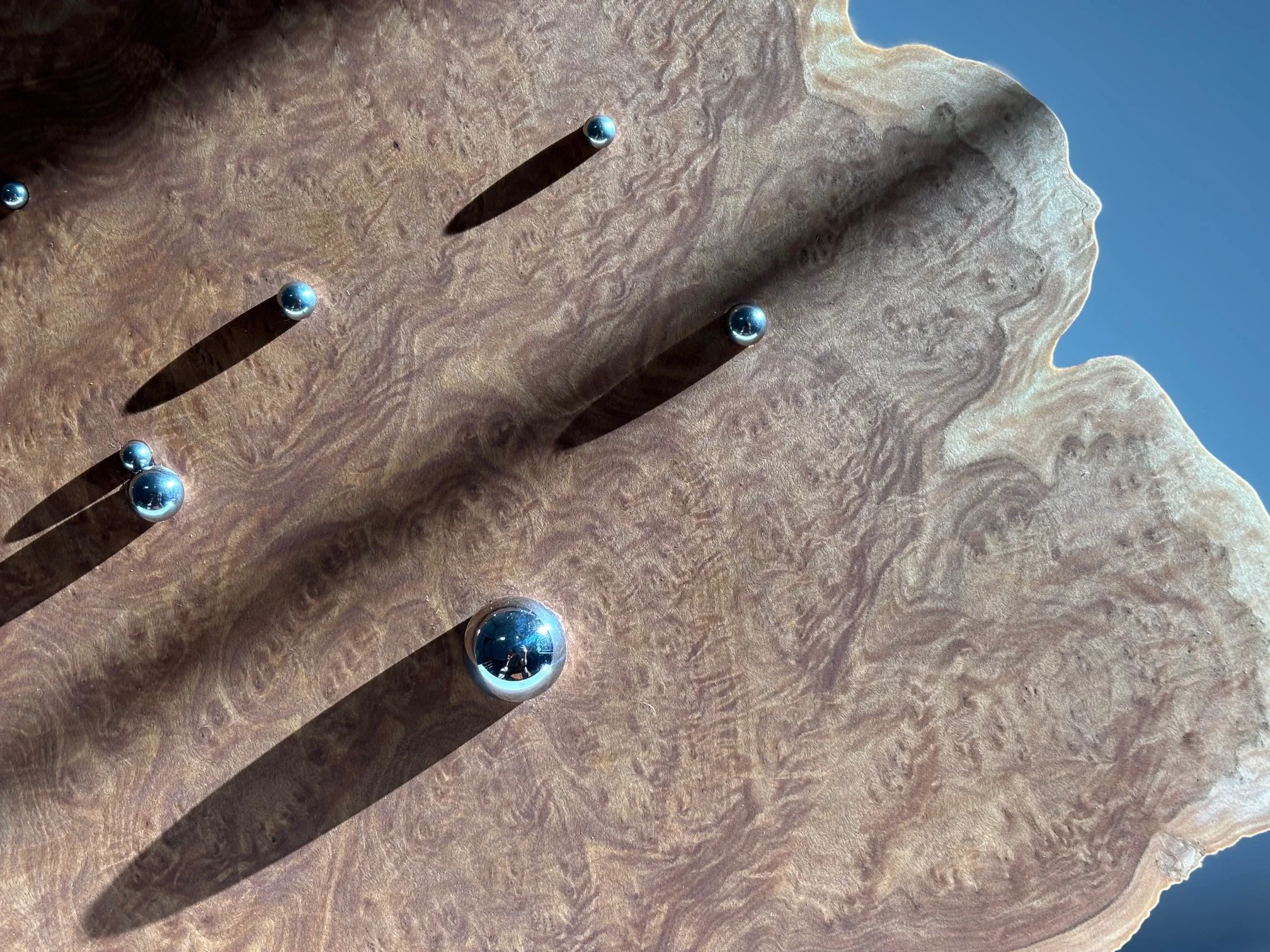 Image 7 of 8
 Image 8 of 8