Australian Red Mallee Burl (Eucalyptus oleosa) stainless steel and epoxy inlays.
17 lbs. 24" x 12" x 6"
Fleeting Existence draws directly from concepts where matter is understood not as an isolated object, but as a temporary excitation stabilized within a continuous field. In this framework, structure emerges where energy settles, however briefly, before shifting again. Peaks, folds, and compressed valleys evoke a potential energy landscape shaped by competing forces. Embedded steel spheres occupy select low and high points, functioning as markers of field behavior: localized concentrations where energy condenses, reflects, or temporarily stabilizes before dispersing again.
The moment the spheres’ reflective surfaces return the viewer’s image, observation becomes participation, echoing the role of measurement in quantum mechanics, where systems are altered by the act of being observed. The work suggests that human existence follows a similar logic: we are not only formed by the forces that surround us, but continuously changed by attention, encounter, and the fragile fact of being seen.
Australian Red Mallee Burl (Eucalyptus oleosa) stainless steel and epoxy inlays.
17 lbs. 24" x 12" x 6"
Fleeting Existence draws directly from concepts where matter is understood not as an isolated object, but as a temporary excitation stabilized within a continuous field. In this framework, structure emerges where energy settles, however briefly, before shifting again. Peaks, folds, and compressed valleys evoke a potential energy landscape shaped by competing forces. Embedded steel spheres occupy select low and high points, functioning as markers of field behavior: localized concentrations where energy condenses, reflects, or temporarily stabilizes before dispersing again.
The moment the spheres’ reflective surfaces return the viewer’s image, observation becomes participation, echoing the role of measurement in quantum mechanics, where systems are altered by the act of being observed. The work suggests that human existence follows a similar logic: we are not only formed by the forces that surround us, but continuously changed by attention, encounter, and the fragile fact of being seen.

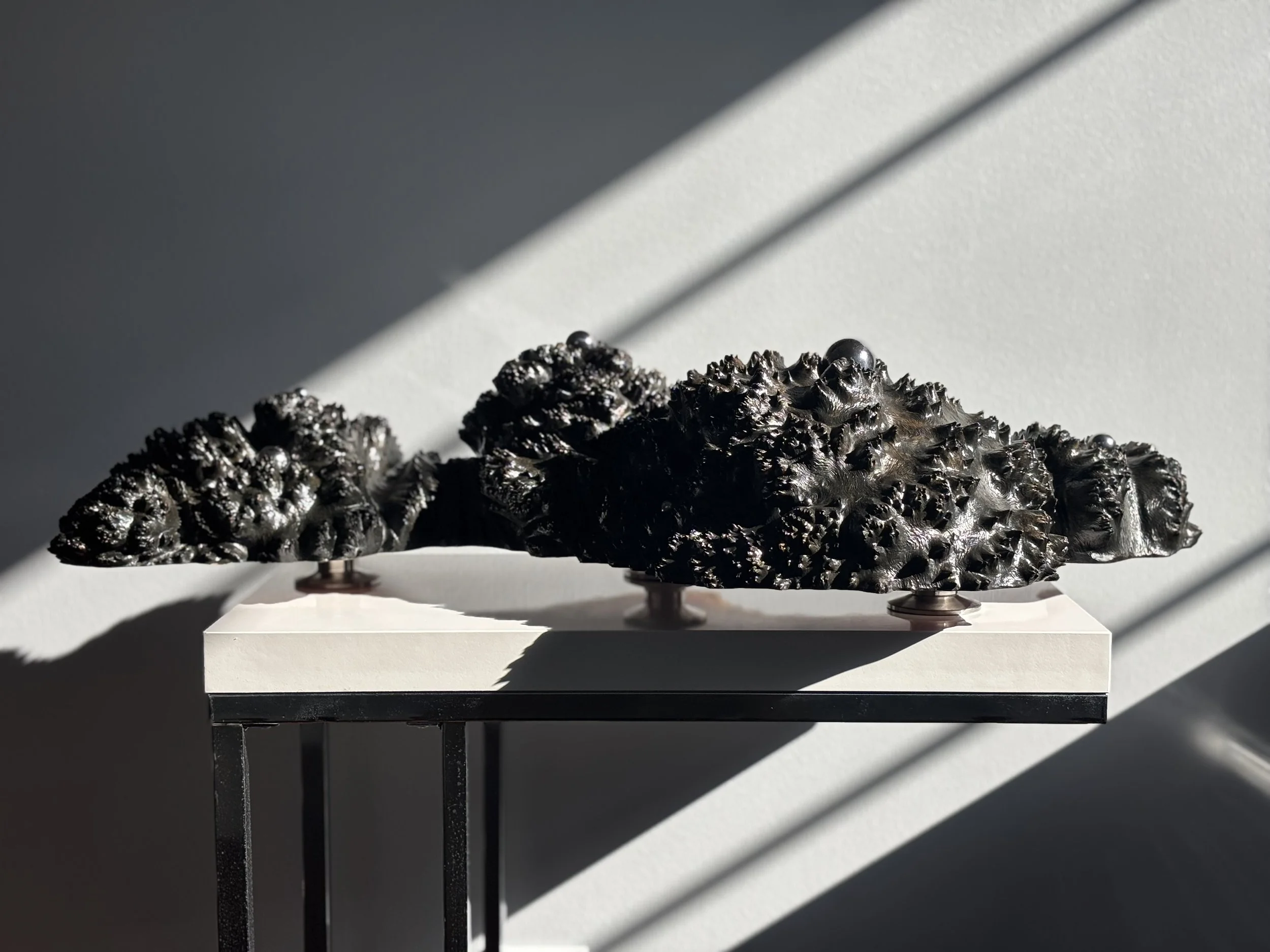 Image 1 of 6
 Image 2 of 6
 Image 3 of 6
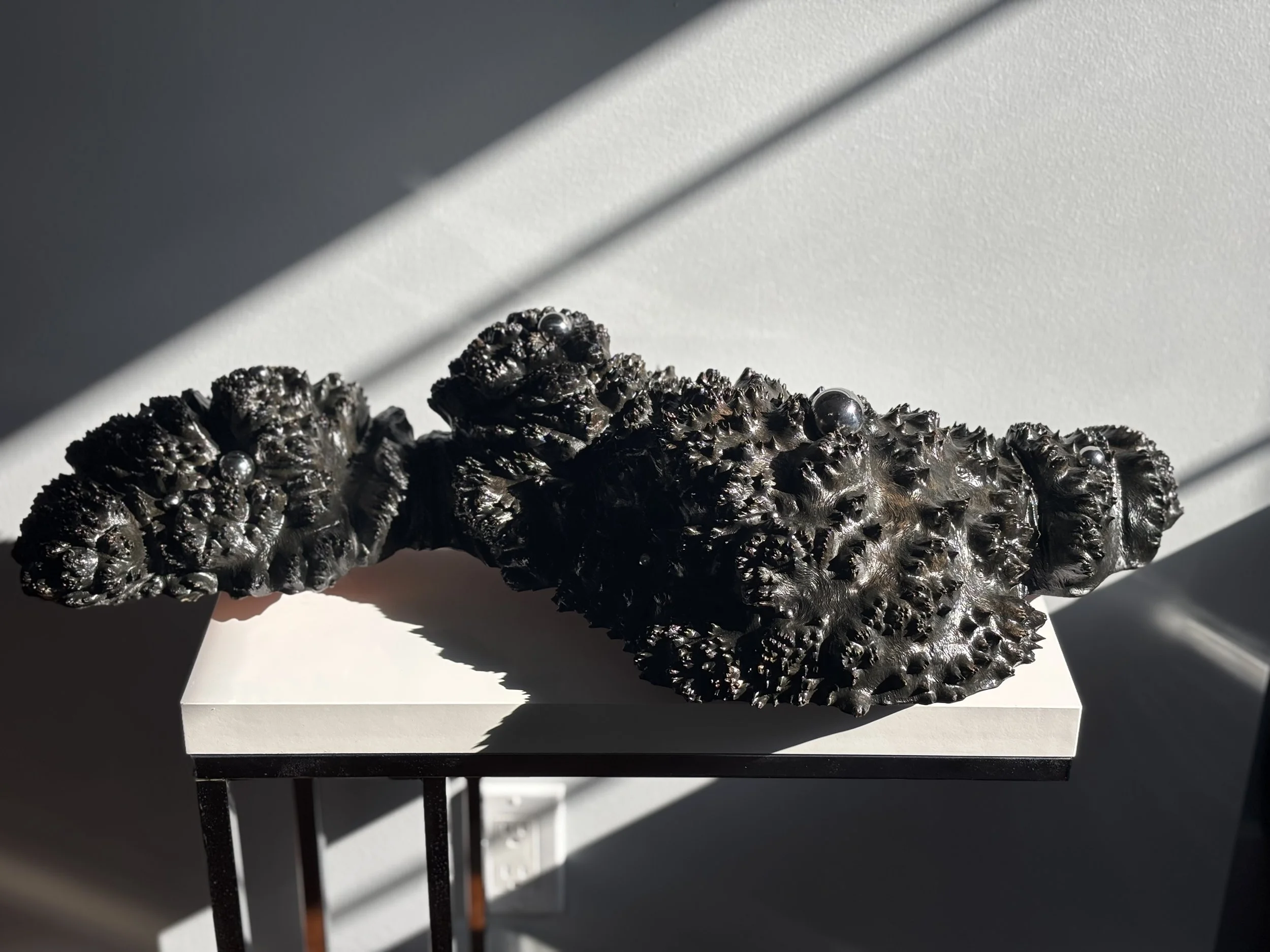 Image 4 of 6
 Image 5 of 6
 Image 6 of 6