Image 1 of 2
Image 2 of 2
Arbitrary & Capricious (CURRENTLY EVOLVING)
Borrowing its title from administrative law, this work examines the boundary between reasoned structure and unjustified intervention. In legal terms, an action is deemed “arbitrary and capricious” when it lacks a coherent rationale—when outcomes appear detached from evidence, precedent, or proportionality. That distinction is translated here into material form.
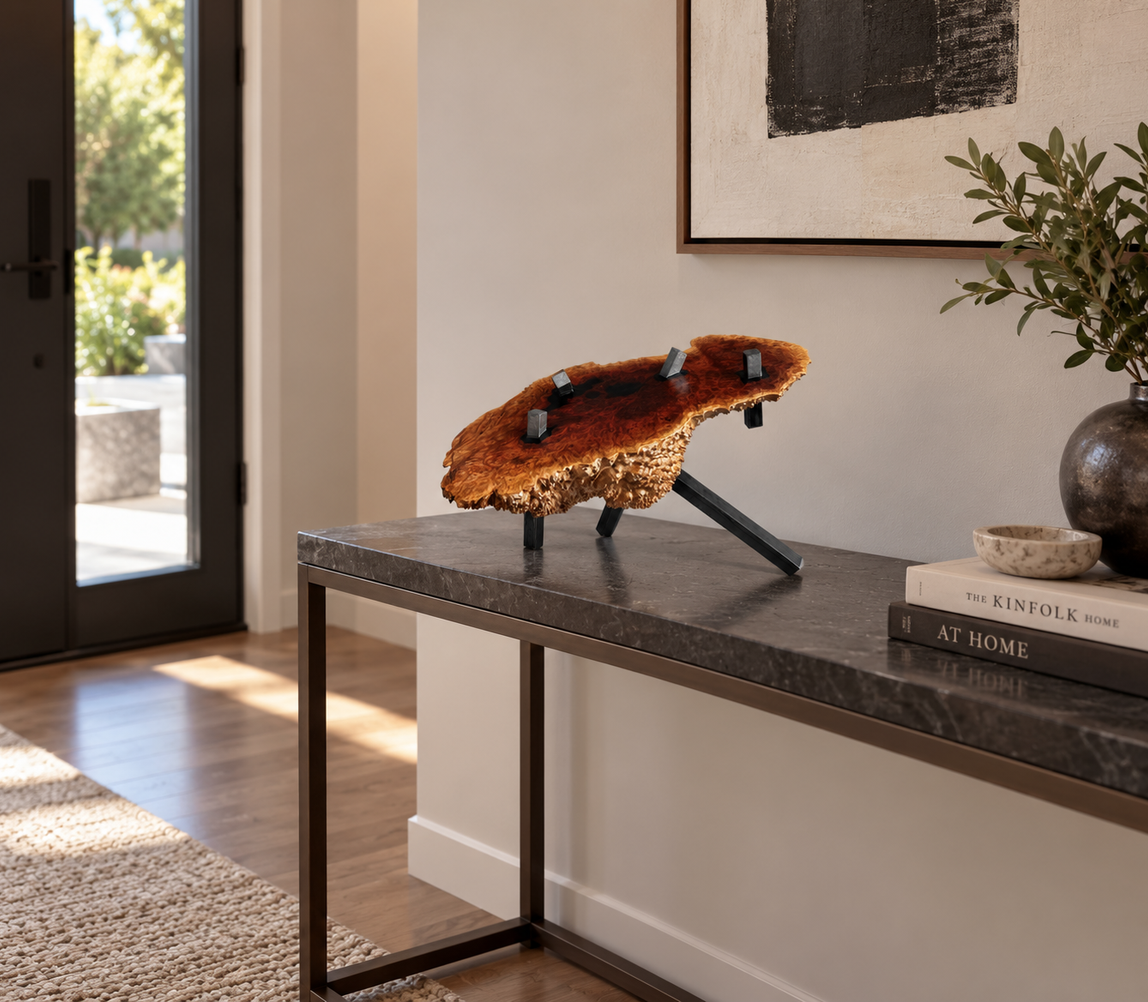
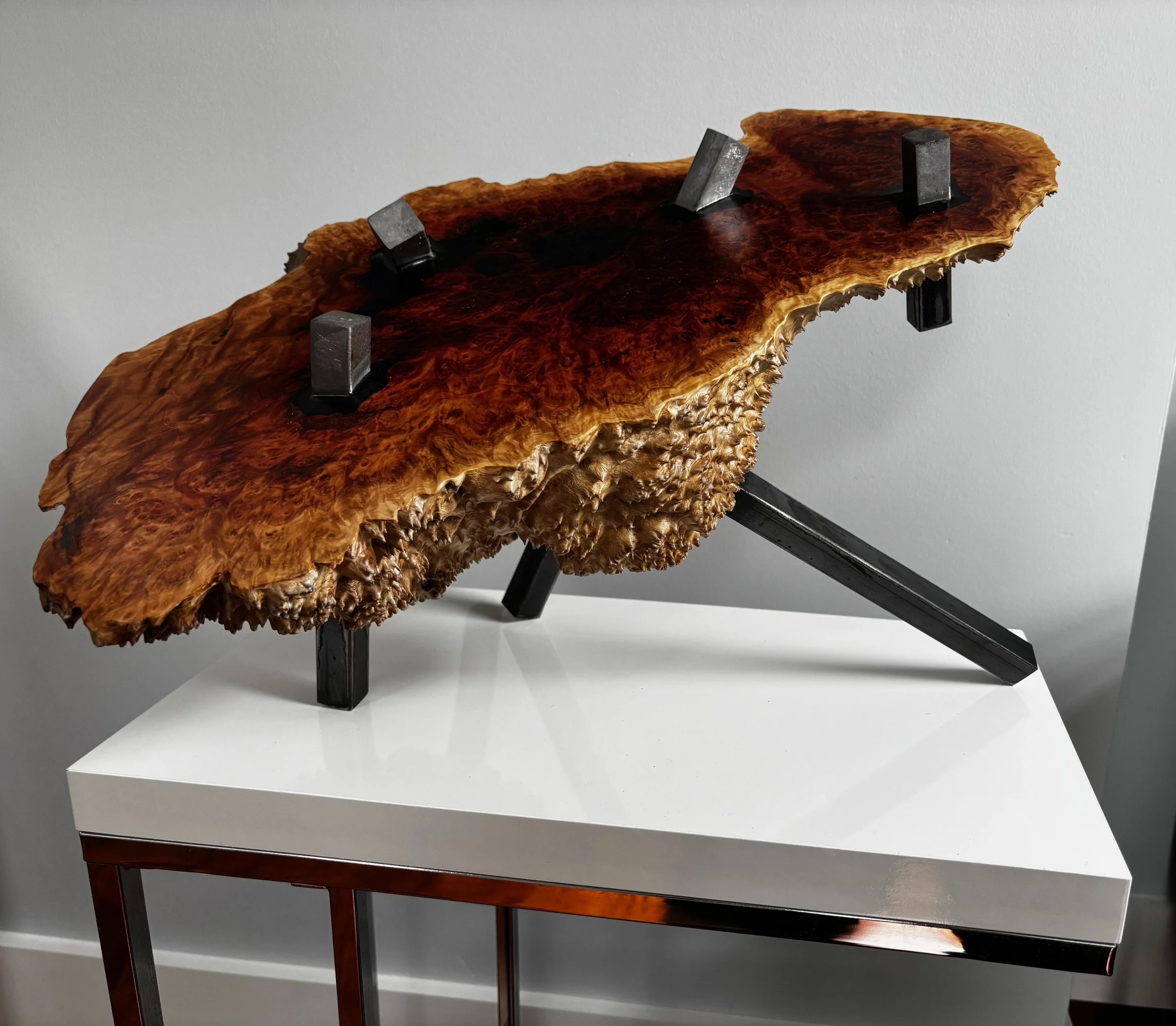
The eucalyptus burl forms the governing body of the sculpture. The wood reads as precedent—an ordered system whose complexity emerges through continuous adaptation. Its growth is cumulative and legible, shaped by stress, repair, and time. Grain lines register cause and effect with biological fidelity; each deformation follows from sustained pressure rather than imposition.
Penetrating this rational field are steel rods inserted at irregular intervals and depths. Their placements follow no visible hierarchy or structural necessity. They do not emerge from the grain or respond to the wood’s internal logic; they interrupt it. No proportional logic governs their dimensions. Minor insertions may exert disproportionate influence, while larger ones appear excessive or unjustified. Neither distribution nor magnitude corresponds to the surrounding material conditions. This indifference—to both site and scale—renders the steel physically arbitrary. Each insertion behaves less like a structural requirement and more like an external decision imposed after the fact. These isotropic elements do not resolve instability or restore order. Instead, they create a condition of managed disruption—forces contained within the structure but never reconciled. The system holds, though unevenly, absorbing interventions that lack justification or proportion.
Arbitrary & Capricious frames coherence as something maintained under continual exception. As throughout Helix & Hewn, stability is defined not by resolution, but by containment—an order sustained despite the persistent presence of decisions that cannot fully explain themselves.
Borrowing its title from administrative law, this work examines the boundary between reasoned structure and unjustified intervention. In legal terms, an action is deemed “arbitrary and capricious” when it lacks a coherent rationale—when outcomes appear detached from evidence, precedent, or proportionality. That distinction is translated here into material form.
The eucalyptus burl forms the governing body of the sculpture. The wood reads as precedent—an ordered system whose complexity emerges through continuous adaptation. Its growth is cumulative and legible, shaped by stress, repair, and time. Grain lines register cause and effect with biological fidelity; each deformation follows from sustained pressure rather than imposition.
Penetrating this rational field are steel rods inserted at irregular intervals and depths. Their placements follow no visible hierarchy or structural necessity. They do not emerge from the grain or respond to the wood’s internal logic; they interrupt it. No proportional logic governs their dimensions. Minor insertions may exert disproportionate influence, while larger ones appear excessive or unjustified. Neither distribution nor magnitude corresponds to the surrounding material conditions. This indifference—to both site and scale—renders the steel physically arbitrary. Each insertion behaves less like a structural requirement and more like an external decision imposed after the fact. These isotropic elements do not resolve instability or restore order. Instead, they create a condition of managed disruption—forces contained within the structure but never reconciled. The system holds, though unevenly, absorbing interventions that lack justification or proportion.
Arbitrary & Capricious frames coherence as something maintained under continual exception. As throughout Helix & Hewn, stability is defined not by resolution, but by containment—an order sustained despite the persistent presence of decisions that cannot fully explain themselves.