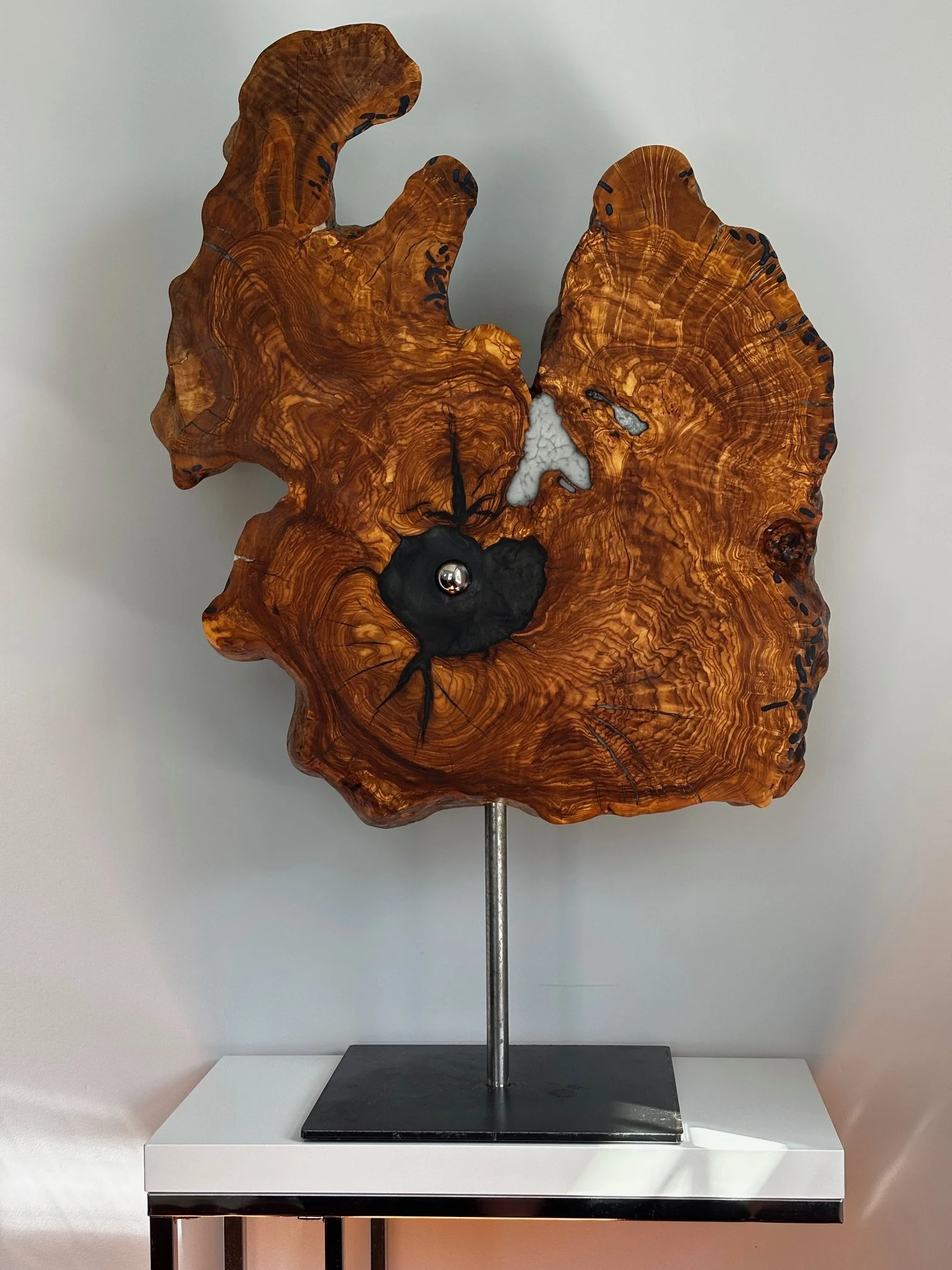
Durable Response (CURRENTLY EVOLVING)

$0.00

Olive wood (Olea europaea) with stainless steel and epoxy inlays.

23 lbs. 21” x 25” x 3”

This work centers on an irregular mass of reclaimed olive wood whose disrupted grain records prolonged biological stress. At its core, a dense black region occupies a central void, representing a malignancy that remains present — contained, but unresolved.

Embedded within this dark mass is a reflective metal sphere. Its mirrored surface captures the surrounding material and the viewer alike, collapsing distance between observer and condition. The sphere signifies that cancer is not an isolated event contained within a single body, but a shared human reality—one that implicates patients, caregivers, families, and communities. Reflection functions here not as self-recognition alone, but as collective inclusion.

Surrounding the core, the material language shifts. Peripheral regions quiet and stabilize, suggesting suppression rather than cure. Within this field, lighter regions function as treatment scar: areas where active malignancy has receded, leaving behind material evidence of intervention rather than restoration. Order reasserts itself not through eradication, but through continuous constraint.

Durable Response does not frame recovery as resolution. It presents remission as a sustained state—defined by vigilance, proximity, and ongoing management—where instability persists, and where all who encounter it are, in some measure, already involved.

Olive wood (Olea europaea) with stainless steel and epoxy inlays.

23 lbs. 21” x 25” x 3”

This work centers on an irregular mass of reclaimed olive wood whose disrupted grain records prolonged biological stress. At its core, a dense black region occupies a central void, representing a malignancy that remains present — contained, but unresolved.

Embedded within this dark mass is a reflective metal sphere. Its mirrored surface captures the surrounding material and the viewer alike, collapsing distance between observer and condition. The sphere signifies that cancer is not an isolated event contained within a single body, but a shared human reality—one that implicates patients, caregivers, families, and communities. Reflection functions here not as self-recognition alone, but as collective inclusion.

Surrounding the core, the material language shifts. Peripheral regions quiet and stabilize, suggesting suppression rather than cure. Within this field, lighter regions function as treatment scar: areas where active malignancy has receded, leaving behind material evidence of intervention rather than restoration. Order reasserts itself not through eradication, but through continuous constraint.

Durable Response does not frame recovery as resolution. It presents remission as a sustained state—defined by vigilance, proximity, and ongoing management—where instability persists, and where all who encounter it are, in some measure, already involved.