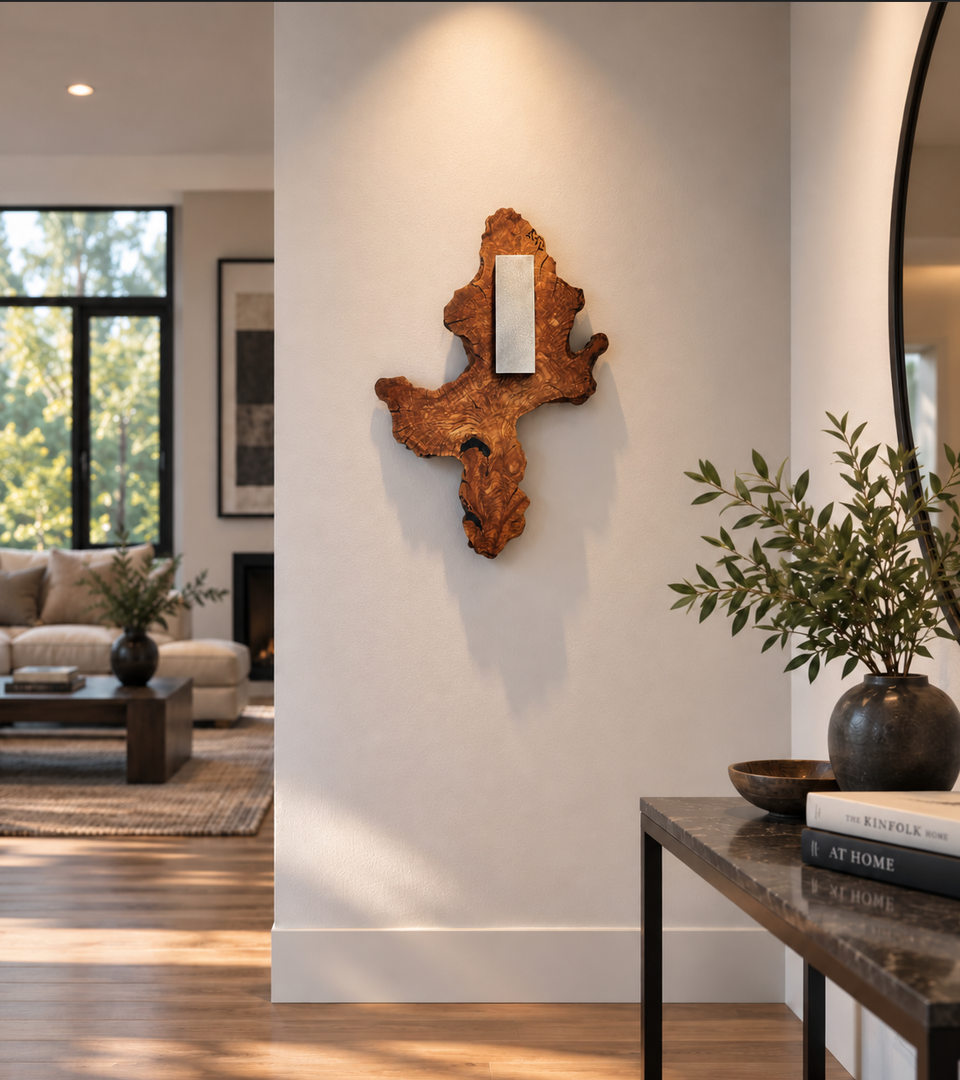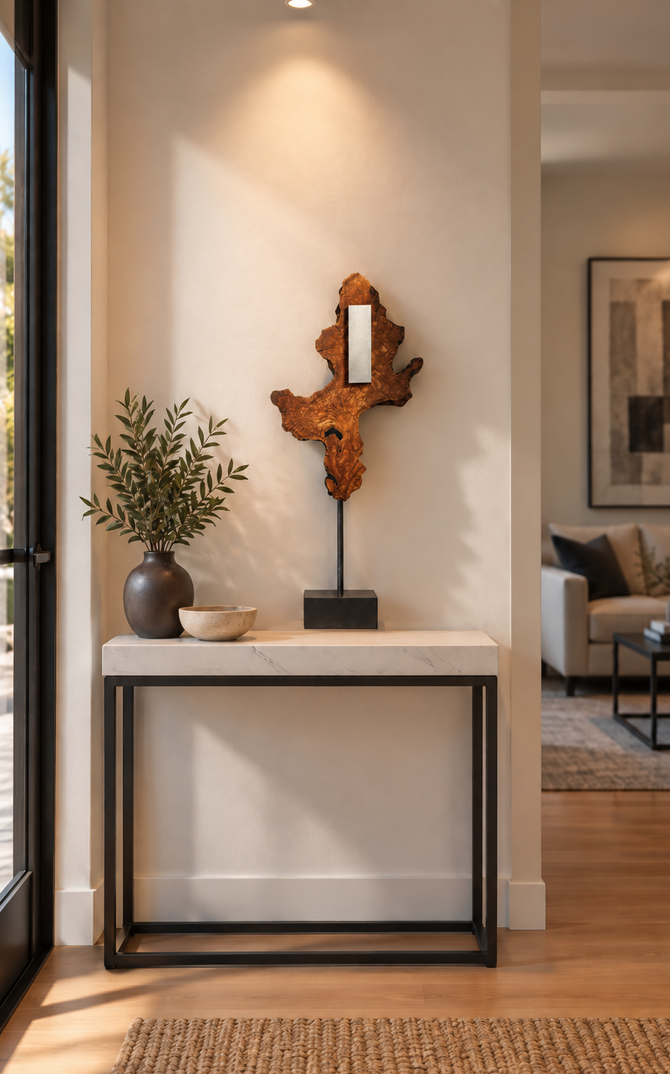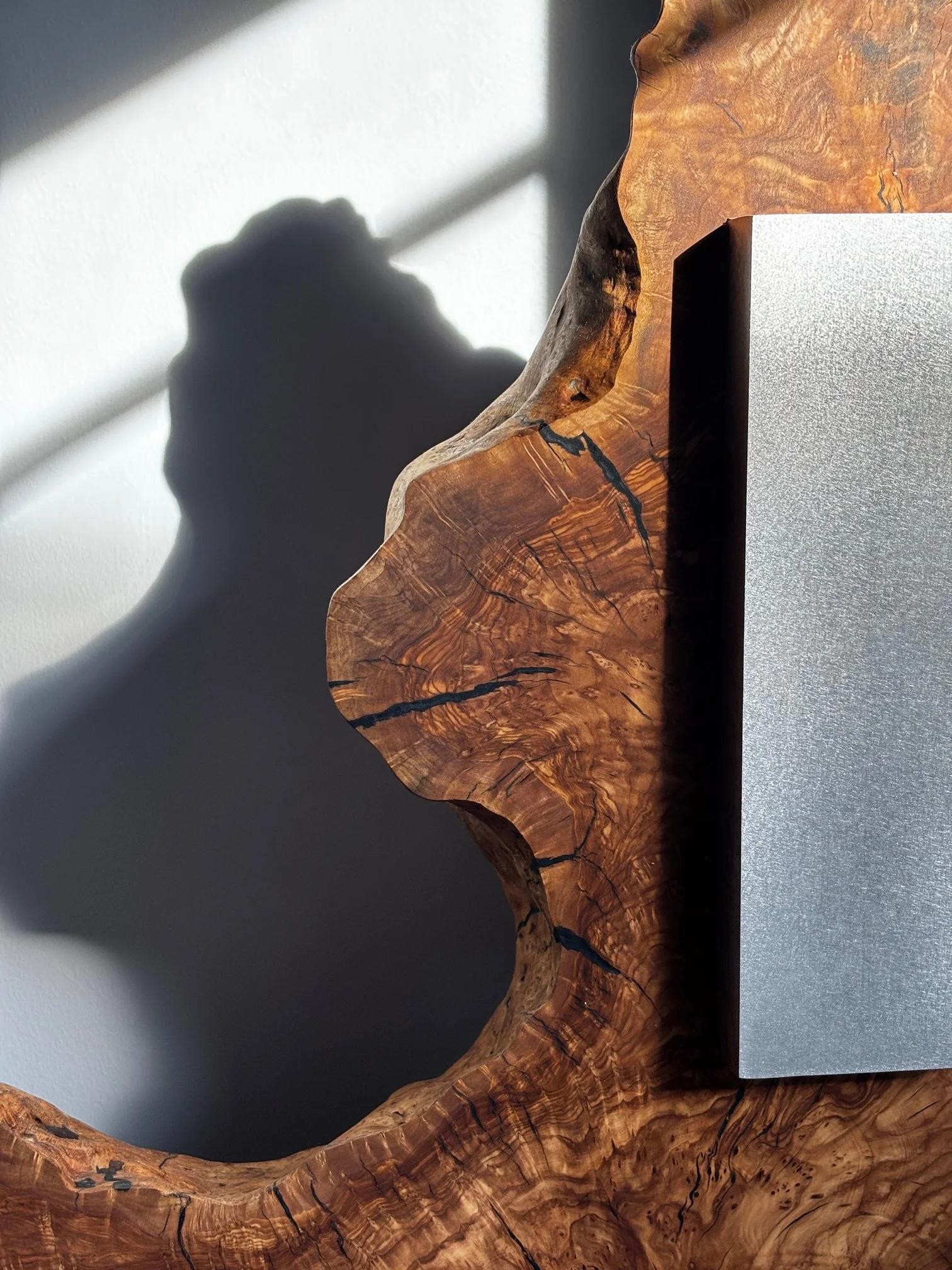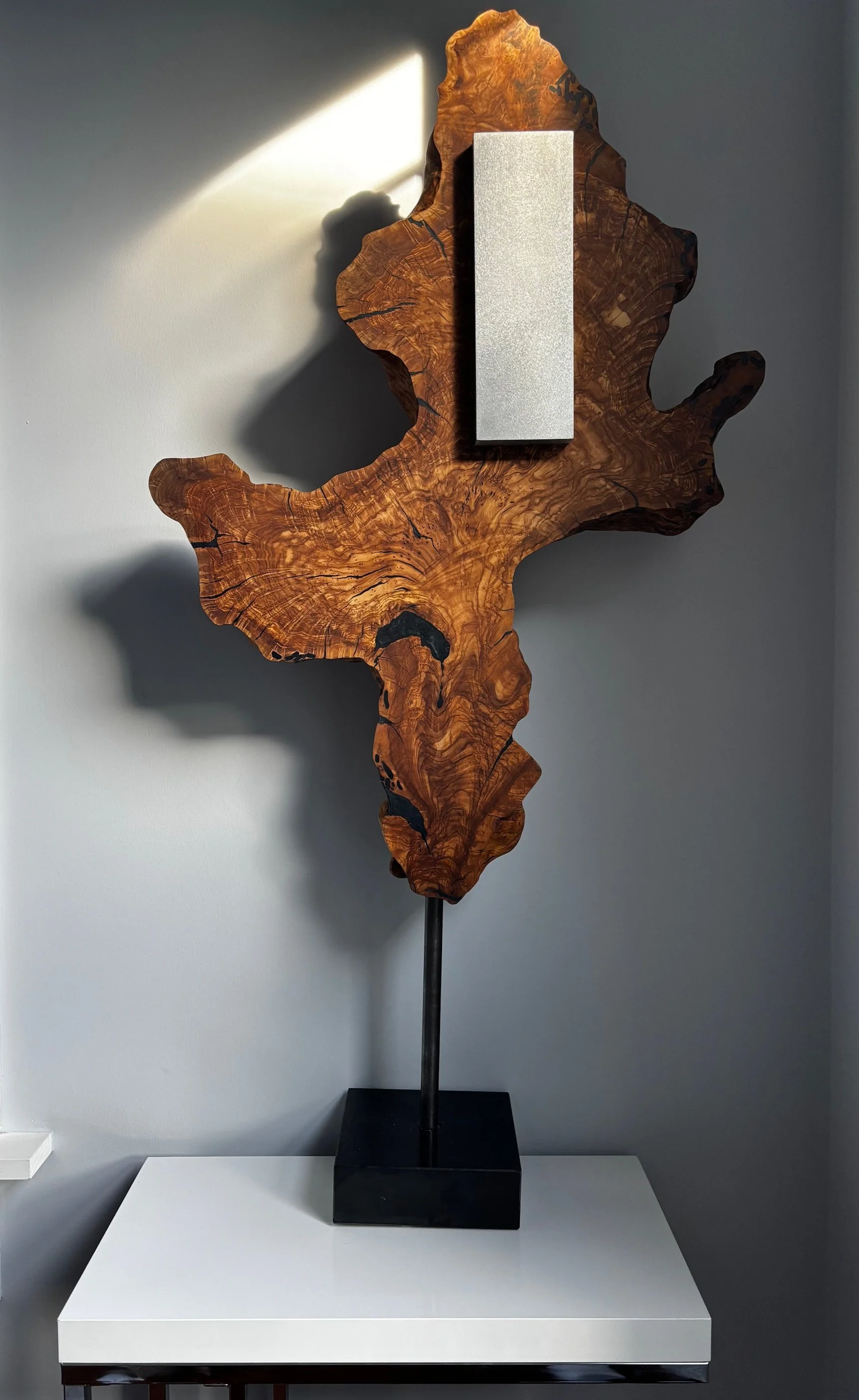
Olive wood (Olea europaea) with stainless steel and epoxy inlays.
17 lbs. 29” x 19” x 3”
This work is structured around a fundamental scientific tension: How can highly ordered, intelligent biological systems emerge and evolve in a universe governed by the Second Law of Thermodynamics, which requires disorder (entropy) to always increase?
Having an irregular perimeter and internally disordered grain, olive wood represents entropy in its most familiar material expression. Its swirling, non-linear structure records stress, growth, fracture, and time — a visible archive of disorder accumulating within matter. Left alone, systems trend toward such diffusion and irregularity.
Embedded at the center is a precisely machined rectangular element of aluminum representing order. The conceptual tension echoes the inquiry posed by Erwin Schrödinger in his 1944 book What Is Life?. Schrödinger asked how living organisms maintain and increase internal order despite the universal drift toward disorder. His answer reframed life not as a violation of thermodynamics, but as a participant within it: living systems are open systems. They sustain internal organization by importing energy and exporting entropy to their surroundings. Order here is local and temporary, purchased at the cost of greater disorder elsewhere.
The aluminum form thus represents intelligent life — not as a negation of entropy, but as a structure that temporarily resists it through energy flow, information, and constraint. Its insertion into the wood does not halt disorder; it coexists with it. The surrounding material continues its irregularity. The larger system still trends toward entropy.
The piece does not resist cosmic entropy. It demonstrates it.
Olive wood (Olea europaea) with stainless steel and epoxy inlays.
17 lbs. 29” x 19” x 3”
This work is structured around a fundamental scientific tension: How can highly ordered, intelligent biological systems emerge and evolve in a universe governed by the Second Law of Thermodynamics, which requires disorder (entropy) to always increase?
Having an irregular perimeter and internally disordered grain, olive wood represents entropy in its most familiar material expression. Its swirling, non-linear structure records stress, growth, fracture, and time — a visible archive of disorder accumulating within matter. Left alone, systems trend toward such diffusion and irregularity.
Embedded at the center is a precisely machined rectangular element of aluminum representing order. The conceptual tension echoes the inquiry posed by Erwin Schrödinger in his 1944 book What Is Life?. Schrödinger asked how living organisms maintain and increase internal order despite the universal drift toward disorder. His answer reframed life not as a violation of thermodynamics, but as a participant within it: living systems are open systems. They sustain internal organization by importing energy and exporting entropy to their surroundings. Order here is local and temporary, purchased at the cost of greater disorder elsewhere.
The aluminum form thus represents intelligent life — not as a negation of entropy, but as a structure that temporarily resists it through energy flow, information, and constraint. Its insertion into the wood does not halt disorder; it coexists with it. The surrounding material continues its irregularity. The larger system still trends toward entropy.
The piece does not resist cosmic entropy. It demonstrates it.